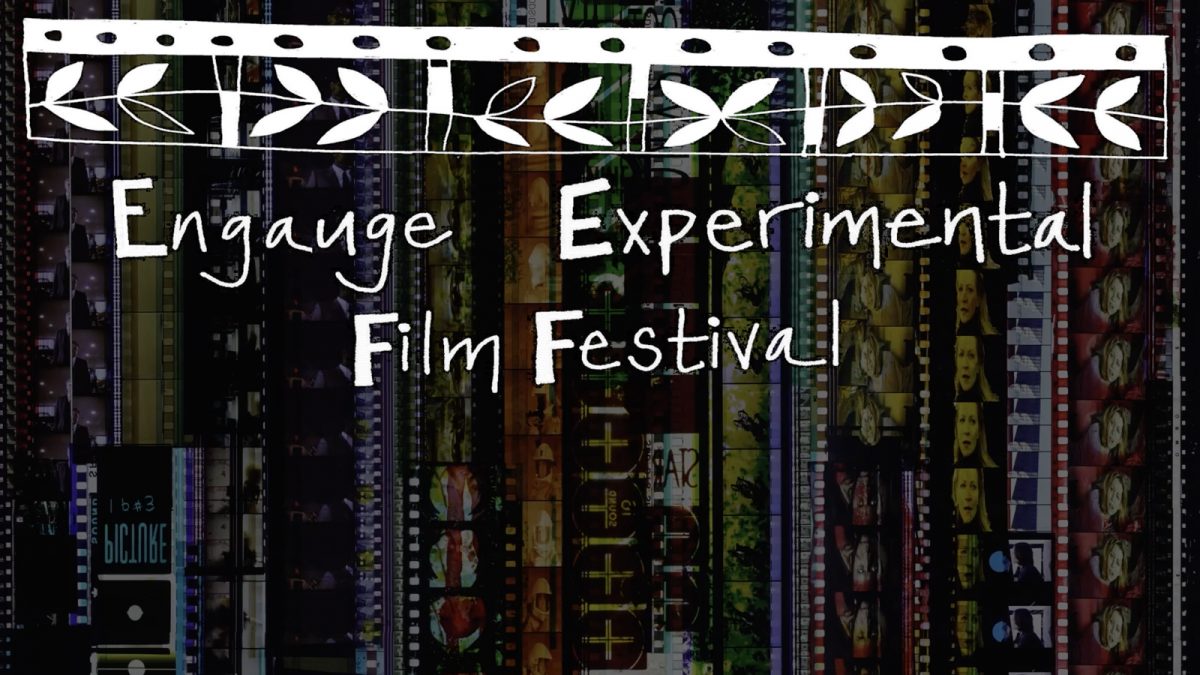
Engauge 2026 – Tactility and Memory
INDIVIDUAL FILM PROGRAM TICKETS:
- $15 General Admission
- $10 Student/Child/Senior
- $7 NWFF/SIFF/GI/PCNW member
INDIVIDUAL TICKETS TO SPECIAL EVENTS:
- $18 General Admission
- $13 NWFF/SIFF/GI/PCNW member
- $70 General
- $50 Student/Child/Senior
- $35 NWFF/SIFF/GI/PCNW member
About
These films posit a connection between the haptic world and what we choose to embody, remember, erase, perhaps forget. Filmmakers manipulate the medium in a variety of ways to emphasize visual texture and showcase techniques that evoke memory and touch.
Ticketing, concessions, cinemas, restrooms, and our public edit lab are located on Northwest Film Forum’s ground floor, which is wheelchair accessible. All doors in Northwest Film Forum are non-motorized, and may require staff assistance to open. Our upstairs workshop room is not wheelchair accessible.
We have a limited number of assistive listening devices available for programs hosted in our larger theater, Cinema 1. These devices are maintained by the Technical Director, and can be requested at the ticketing and concessions counter. Also available at the front desk is a Sensory Kit you can borrow, which includes a Communication Card, noise-reducing headphones, and fidget toys.
The Forum does NOT have assistive devices for the visually impaired, and is not (yet) a scent-free venue. Our commitment to increasing access for our audiences is ongoing, and we welcome all public input on the subject!
If you have additional specific questions about accessibility at our venue, please contact our Patron Services Manager at rajah@nwfilmforum.org. Our phone number (206-329-2629) is voicemail-only, but we check it often.
Made possible due to a grant from Seattle Office of Arts & Culture, in partnership with Sensory Access, our Sensory Access document presents a visual and descriptive walk-through of the NWFF space. View it in advance of attending an in-person event at bit.ly/nwffsocialnarrativepdf, in order to prepare yourself for the experience.
NWFF patrons will be strongly encouraged to wear masks that cover both nose and mouth while in the building. Disposable masks are available at the door for those who need them. Recent variants of COVID-19 readily infect and spread between individuals regardless of vaccination status.
Read more about NWFF’s policies regarding cleaning, masks, and capacity limitations here.
Films in this program:
Caribou
(Lindsay Aksarniq McIntyre | color/sound | 16mm to digital | 15:00 | CA)
An experimental documentary created with handmade and manufactured emulsions exploring the close and enduring connections between Inuit, caribou, lichens, and land use. Lichen developers help bring the images to life, while caribou hide is processed into gelatin to make handmade emulsion. Filmed primarily on the land in Nunavut where caribou struggle to maintain their lifeways amidst burn events, habitat disruption and changing conditions.
I Found Some Old Footage of a Tree
(Krista Lee Steinke | color/sound | 16mm to digital | 3:22 | US)
An experimental film that unfolds as a glimpse into the creative process: a sketch, a vignette, a visual mind map, and a meditation on how to document a planet in flux. In this piece, the materiality of film becomes a metaphor for time, impermanence, and the fragility of the natural world. Working with Super 8mm and 16mm footage, the image itself carries traces of transformation, decay, and memory, blurring the boundaries between document and artifact. A sense of anxiety and urgency shapes the work, leaving us uncertain whether we are witnessing the past, the present, or a message from the future. Ultimately, the film asks how cinema can hold onto a world that is continually changing, and what remains when both landscapes and images begin to disappear.
EOJ
(Tianming (Alaric) Zhou b&w/sound | 16mm to digital | 2:22 | China/US)
Regulatory signs shot on 16mm, hand-processed with caffenol, and subjected to both analog and digital corrosion. EOJ reimagines the anxiety induced by caffeine hypersensitivity and the pressures of social conditioning.
Autopsia del Río
(Ada Rajkovíc | color/sound | Super 8 to digital | 2:37 | US)
Inspired by David Gatten’s “What The Water Said,” this film uses the material of Super 8 celluloid itself to record the memories of the Río de la Plata, a former burial ground for los desaparecidos during Argentina’s military dictatorship.
Flow Attachment
(Tijana Petrovic | b&w/sound | 16mm to digital | 8:40 | US)
A coastal sand dune is transformed and reshaped into digital ether. The film focuses closely on sand as a material, which is composed of silica, the mineral that is a primary ingredient in manufacturing silicon chips, lenses, binoculars, microscopes and mirrors – devices that extend our vision. The film uses these devices to visually capture the sand dune and evoke the transformation of materials that goes into their production. Through 16mm analog techniques, elemental forces of a sand dune merge with the physical properties of the celluloid.
Polychora
(Abinadi Meza | color/sound | 16mm to digital | 9:22 | US/Mex)
A cameraless 16mm film, scanned to 4K and slowed into extreme temporal dilation: an aqueous prism where chromatic membranes evolve. Its title evokes the polychoron, a four dimensional form. Fractal traces surface within the color fields: analog and digital, cellular and cosmic, coexisting in the same luminous space. Polychora functions as a neuro refuge, a haptic cinema where the eyes and body can rest inside something vast.
Tactile Light Diary
(Callon Murphy | b&w/sound | 8mm to digital | 6:00 | CA)
Touch replicated through audiovisual means./Fabric structures exposed and magnified.
Textiles dance over microphone and screen./Images burst to the forefront.
First a beach, then an unclean pool./Summer slips into fall./ Details are forgotten or misremembered./The retained memory of tactile objects.
Need and Desire
(Francesca Svampa | color/sound | Super 8 to digital | 8:24 | Spain/Italy)
A gesture of erasure. A spell. If you lift the emulsion from a photograph, destroy its surface, transplant it onto a new body, does the memory it carried survive? “Need and Desire” originates from this question, and from the poetic belief that making a film can alter reality. The cinematic act becomes [an] incantation: a process that destroys and reconstructs simultaneously. Still memories become an “emulsional” landscape.
Fata Morgana
(Hannu Nieminen | color + b&w/sound | Super 8 to digital | 5:16 | Finland)
Fata Morgana is a mirage phenomenon in which distant objects appear distorted, often floating or stretched out on the horizon. The film is an experimental study of memory, images and filming, and how memories can transform, rust and disintegrate. The photographs are from a summer spent on the banks of the Terijoki River in Karelia, which [the] Soviet Union took from Finland after WWII.
Interwoven Intervals
(Laura Kraning | b&w/sound | 16mm to digital | 6:00 | US)
Pattern drafts are the graphical score for weaving – grids of light and dark representing the over and under of weft threads between the warps. In this material hybrid of film and textile, the graphic repetition of grids, lines, and squares assert a structural form that is fragile and vulnerable to erasure.
La Duréte du Mental/Mental Toughness
(Charles-Andre Coderre | color/sound | 35mm to digital *wide* | 20:00 | CA)
“It’s a distraction for many, a profession for a few, when for me sport is my whole life. And if fighting is the reason you’re living. If every muscle clamors : train me, exercise, put on a sprint. Find a competitor or at least fight against a pole. It’s hard to get started but it’s otherwise difficult to stop. Even with your back against the mat. Never mind. You have to stand up and go further. You will now have to fight against yourself.” Transforming Olympic wrestling and pole vaulting Soviet films from the 1980s into expressive, painterly imagery, the film appears as a film practitioner’s decathlon.